Engineerless AI

Build Anything. No Engineering Required.

The engineering team you never have to hire.

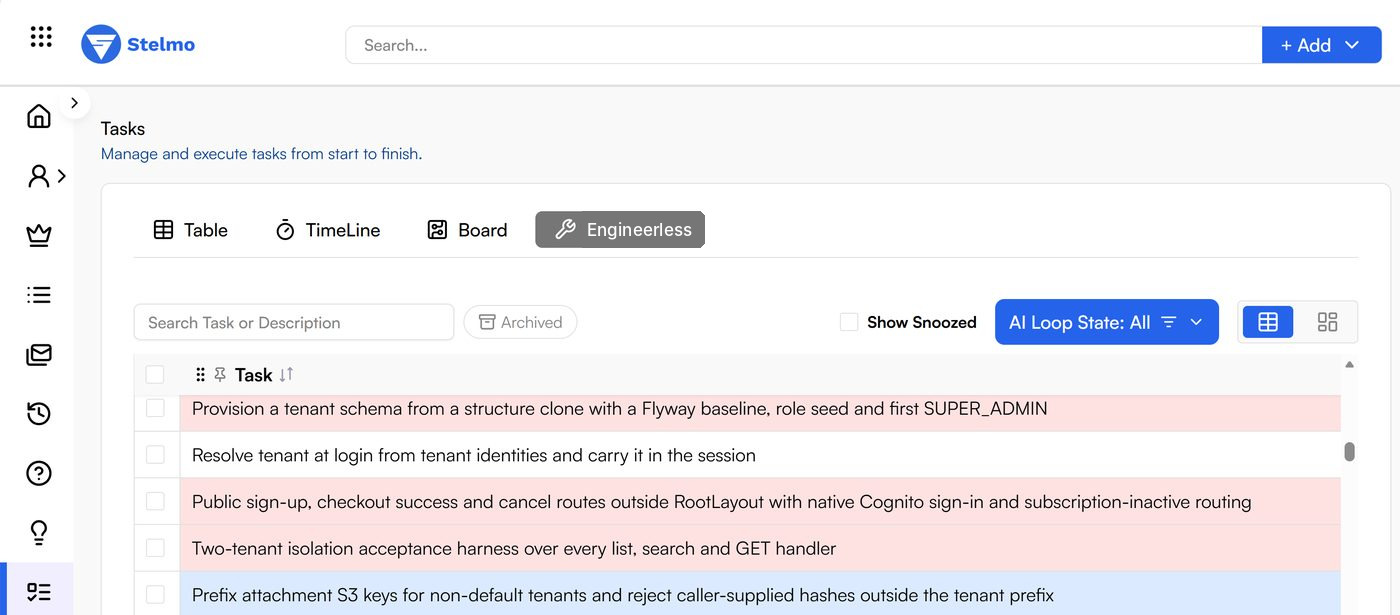
Engineerless is an autonomous builder that works in your GitHub and your cloud. Describe what you want in plain language. Engineerless writes, tests, and fixes code. Review in staging, approve what ships to production.

How it works
engineerless · nightly build · your-org/your-app

Why

Self-driving cars used to be science fiction.

Taxi or Uber, you were at the mercy of whoever was behind the wheel. Entrepreneurs know the feeling. Everywhere you want to go relies on an engineer. Until now.

Engineerless does for enterprise software what driverless cars did for transportation. Take your stack where you want, when you want. No engineering required.

Founder first

I built Engineerless to build my own company.

I'm a venture capitalist and tech entrepreneur. I have managed more than 100 engineers, so I know what it means to lead an engineering team: the good, the bad and the ugly.

I didn't want to build Stelmo the old way. So I built an enterprise recruiting platform with no engineering team. I describe what I want, the builder does the work overnight, and I approve what ships.

Randall Crowder, founder of Stelmo AI and Engineerless AI. West Point graduate, 10 years as a venture capitalist, 8 years as a tech founder and operator, including COO of a public company.

Stelmo: A Case Study

7 June to 17 September 2026 · 102 days

165
production releases, about 11 a week
0
reverts across 1,335 merged changes
495
backlog items shipped by the overnight builder
10.6 hrs
median from pull request to merge

Who this is for

People who know what they want built and are tired of waiting on someone else to build it.

Founders with a product in their head

You can describe the feature, the screen, the rule. Engineerless turns that description into working software.

Operators who own a process

You run the business and the software runs your process. Changes come from your team's requests, not a vendor's roadmap.

Teams with an engineer or two

Your engineer(s) review pull requests instead of writing every line. Engineerless does the first draft, the tests, and the fixes. Your engineer(s) approve what ships.

What the builder does

It does not stop at writing code.

It fixes its own failures

When a test fails, the builder reads the failure, changes the code and runs it again before anyone sees it. Each pull request carries an after-action record: what was tried, what broke, what fixed it. Lessons that repeat become standing rules, so month six runs better than month one.

  • Failing checks fixed and re-run in the same build
  • An after-action record on every pull request
  • A help assistant in your own Claude for setup and runbooks

Controls you can show an auditor

Every change is a pull request that a named person approves. Secrets stay in your own secret store, never in a file. The builder reads code and work records. It never reads your customers' data and never holds production write access.

  • Human approval on every merge and every release
  • An automated review on every pull request
  • A daily cost cap and a kill switch

Built for systems with moving parts

Relational databases with versioned migrations. Sign-in with roles. A web application, an API, background functions, a calling service and a realtime relay, each with its own pipeline. That is the platform the builder runs today.

  • Six services, one builder, one approval flow
  • Database changes checked for version order
  • Staging first, production on a second approval

How it compares with your other options

Hire a teamEngage an agencyAI coding assistantEngineerless
Who reviews codeA technical lead you recruitTheir peopleYou or an engineer, every sessionNobody. The builder manages automated reviews, tests, and loops.
When are work hoursBusiness hoursTheir scheduleWhile someone sits at the keyboardOvernight or on-demand, unattended.
When something breaksYour team debugsFile a ticketYou prompt it againThe builder reads the failure, fixes it, and records lessons learned.
Where the code livesYour repositoriesDependsYour repositoriesYour repositories. Your cloud.
What you payAbout $16,200 a month per engineer, fully loadedProject fee or retainerA subscription plus your timeA pilot for 10 shipped changes, then a flat fee from $2,500 a month, plus your own model usage.

Engineer cost: $194,500 a year fully loaded, from U.S. Bureau of Labor Statistics wage and compensation data. The math is in the proof section.

How it compares to other AI solutions

Prompt-to-app builders and coding agents are good tools. They are built for a different job. Engineerless runs your whole backlog in your own repositories and cloud, unattended, and you approve what ships.

EngineerlessLovableReplitDevinCursor
Built forFounders and operators who do not codeNon-coders building new web appsBuilders prototyping on ReplitEngineering teams delegating tasksEngineers writing code in an editor
Where your code livesYour GitHub repositories. Your cloud.Lovable's platform; exports to GitHubReplit's platform and hostingYour repositories; work runs in Devin's cloudYour machine and repositories
Existing production codebaseYes. That is the job.Built for new appsBuilt for apps on ReplitYesYes
Who does the workThe builder, unattended, overnight or on demandYou, prompt by promptYou, prompt by promptDevin, one assigned task per sessionYour engineer, with agents in the editor
Backlog and prioritiesBuilt in. Scored on entry, sequenced by the builder.Yours to manageYours to manageYou assign tasks from your own trackerYours to manage
Before anything shipsAutomated review and tests, a staging deploy, then your approvalBrowser preview; you publishPreview; you deploy on ReplitTests and a pull request; your engineer reviews and mergesYour engineer tests, reviews and merges
Deploys toYour cloud: staging first, production on your approvalLovable hosting; custom domain on paid plansReplit hostingA pull request; your pipeline deploysYour pipeline
How you payOne flat monthly price to Engineerless. No seats, no tokens. Model calls bill to your own provider account.Monthly credits per message, plus top-upsSubscription plus effort-based agent usagePer seat with quotas and on-demand credits; compute units on EnterprisePer seat with model-usage pools; overage billed per token
Needs an engineer on your sideNoNoNoYes, to direct and reviewYes. It is an engineer's tool.

Competitor descriptions are taken from each company's public pricing and product pages, read November 2026, and summarized in our words. Plans change; check theirs.

How it works

Engineerless is your enterprise software development superpower.

  1. Evening

    Define

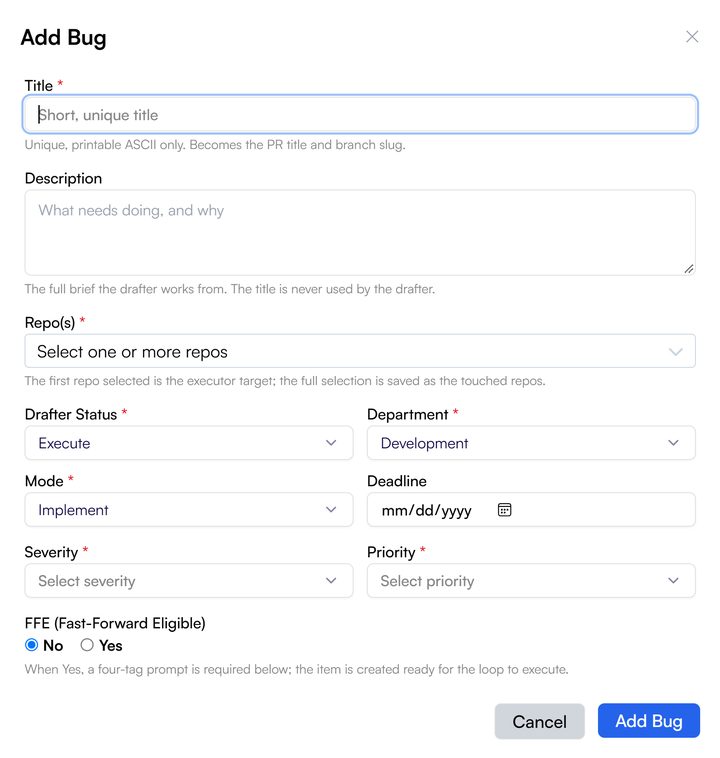
    Write what you want in plain language. If the request is unclear, the builder asks one question back.

  2. Night

    Prioritize

    The builder drafts a specification, scores every open request and picks tonight's work under your cost cap.

  3. Night

    Build

    It writes the code in an isolated copy, runs your tests and fixes what fails.

  4. Morning

    Approve

    You get a pull request with a one-line summary, the acceptance criteria and an after-action record. Approve or decline.

  5. Same day

    Ship

    Approval deploys to staging. You try it. Production is a second, separate approval.

Your vision. Your code.

Your code stays in your repositories and your data stays in your cloud. The runner on your machine does the work. Our service tells it what to do next. Your model key travels with each request and is never stored.

Yours

Your repositories

A GitHub organization you own, with the branch protection you set and the approvers you name.

Yours

Your cloud

Staging and production in your own account. The builder gets a scoped staging role and nothing more.

Yours

The runner

Open source, on a machine you own, with your model key. It schedules the nightly build and posts the report.

Ours

Engineerless AI

The builder's brain: drafting, scoring, selection and checks. It sends decisions, stores no key and sees no customer data.

Enterprise

Built so your security reviewer can check every claim.

Each line here describes how the builder runs today. Ask for the security overview and hold it against your own questionnaire.

Request the security overview

Runs in your cloud and your repositories

Nothing of yours is hosted by us. The builder gets a scoped, staging-only role that you can revoke at any time.

Your model account, your meter

Every model call runs on your own key, including our service's calls. You set the cap. We bill a flat fee and no tokens.

A named approver on every change

Every merge and every release needs a person. Production is its own approval and never follows automatically.

Outside the data path

The builder reads code and work records, never application data. Regulated data stays in your systems under your agreements.

Audit log by design

Applications built on our foundation write one structured event per signed-in request, stored where the application cannot rewrite it.

Cost cap and kill switch

The runner enforces a daily spend ceiling. A per-customer switch stops the service within one run.

Pricing

Launch your builder for less than half an engineer.

Not sure? Start with the Pilot. Your $500 comes off your first month on any plan.

Start here
Pilot

See it ship before you commit

For anyone who wants proof on their own product first.

$2,000 $500
10 merged pull requests
Limited Time Offer. Save $1,500.

The same 10 changes from an engineer cost about $16,600.

  • 10 changes built, tested and merged with your approval
  • Pay only for what you approve. Unmerged work is free, and a change reverted within 30 days is credited back
  • Your full $500 comes off your first month on any plan
  • One builder on one product, up to 2 features or fixes a night
  • 60 days to use them, starting at your first shipped change
  • Setup guide, help assistant and email support
Get started

One payment. No subscription.

Founder

Develop without hiring a team

For founders building one product with no engineers on payroll.

$2,500
a month, flat

About 15% of what one engineer costs.

  • One builder working on your product every night
  • Up to 5 features or fixes built a night
  • One product, up to 3 codebases (repositories)
  • Help assistant inside your own Claude, for every question along the way
  • Email support

Coming from the Pilot? Your first month is $2,000.

Get started

Month to month. Cancel anytime.

Best value
Team

Give your engineer(s) superpowers

For companies with engineers or an agency that want better output.

$7,500
a month, flat

4x Founder capacity. Less than half the cost of an engineer.

Everything in Founder, plus:

  • Up to 20 features or fixes built a night
  • Unlimited codebases
  • The approvers you name sign off before anything ships
  • Build reports in Slack: what shipped and what's waiting on you
  • Operator kit in Claude
  • A named support contact
  • Add a builder for another product: $5,000 a month
Get started

Two months free on annual.

Enterprise

Scale across every product

For multi-product groups where security and scale matter.

$15,000+
a month with annual agreement

Two builders for less than the cost of one engineer.

Everything in Team, plus:

  • Two builders included, more as you grow
  • A licensed source foundation, so you start from a working platform instead of a blank repository
  • Your security questionnaire completed, with an audit log walkthrough
  • Availability commitment and continuity terms in your contract
  • Guided onboarding with a named lead
Get started

Starts with a scoping call.

Every plan includes

  • Runs in your GitHub and your cloud. You own the code.
  • Nothing ships without your approval.
  • AI usage bills to your own provider account, under a daily cap you set.
  • One flat monthly price to Engineerless. No seats, no tokens.
Show the math behind these prices

What an engineer costs

  1. $135,980 median software developer wage (U.S. Bureau of Labor Statistics, May 2025)
  2. ÷ 69.9%, wages as a share of total employer compensation (BLS, March 2026)
  3. = $194,500 a year, or $16,200 a month, before recruiting, management and tooling

What one shipped change costs

  1. An elite team merges 2.25 changes per engineer per week (LinearB benchmarks), or 9.75 a month
  2. $16,200 ÷ 9.75 = $1,662 per shipped change from an engineer, so 10 changes cost about $16,600
  3. Pilot: $500 ÷ 10 = $50 per shipped change, about 3% of that figure. At the $2,000 list price it is $200, about 12%

What the plans cost against an engineer

PlanPer monthShare of one engineerShare of two engineers
Founder$2,50015%8%
Team$7,50046%23%
Team plus one more builder$12,50077%39%
Enterprise$15,000+93%46%

A worked example

Three engineers cost about $48,600 a month. A team that goes to two engineers and adds Team pays $39,900 a month, about $8,700 less, and the two who stay review pull requests instead of writing every line. Add your own model usage: a $25-a-day cap is at most $750 a month.

Engineer figures are national medians. Your own payroll is the better benchmark, so we will run this with your numbers on the first call.

One engineer vs the Team tier, one year

Less than half the cost of one engineer.
The merge volume of twelve.

Every figure is labeled: MEASURED on Stelmo, the first company built on Engineerless; PUBLISHED from a government or vendor source; or an ESTIMATE we show the math for.

Questions founders ask

How does the pilot work?

You prepay $500 for 10 shipped changes (merged pull requests) on one product. The 60-day clock starts at your first shipped change, not at signature. Documentation-only and unmerged changes do not count. A change reverted within 30 days is credited back. When you move to a plan, the $500 comes off your first month.

What do I need to get started?

A GitHub organization, a cloud account, a model provider account and a computer that stays on overnight to host the runner. Setup follows a written guide, with a help assistant inside your own Claude.

What happens when the builder gets stuck?

It stops and says so. A request it cannot finish safely on its own is parked with the reason and waits for a person. It does not guess its way into your codebase.

Does the builder see my customers' data?

No. It reads code, test results and work records. Where it has production access at all, that access is read-only metadata through supervised run sheets that never print a data value.

Who pays for the model calls?

You do, directly, on your own provider account with a cap you set. Our service uses the key your runner sends with each request and never stores it. We charge a flat fee and nothing per token.

Can it work on an existing codebase?

Yes, where the repository has tests the builder can run. We check that on the first call. You can also start from our licensed foundation, so the first weeks are features and not plumbing.

What happens if Engineerless goes away?

The same as if any development tool went away, with more left in your hands. Your code, your repositories and your cloud were always yours. The runner is open source. Every record the builder wrote lives in your repositories. You would lose the nightly automation and nothing else.

Tell us what you want to build.